
You type a question into an AI tool. The answer comes back vague, too long, or just not what you wanted. So you think: "AI isn't that good."
Often, the problem is not the AI. It is the question.
AI cannot read your mind. It only knows what you tell it. The more clearly you explain what you want, the better the answer. This skill has a name: prompting. And you do not need to be technical to learn it.
What Is a Prompt?
A prompt is simply the message you give to an AI tool. It can be a question, an instruction, or a request.
Compare these two:
Weak prompt: "Write about coffee."
Better prompt: "Write a friendly 150-word introduction for a blog post about why coffee tastes different in different countries. Use simple language."
The second prompt tells the AI what to write, how long, for what use, and in what style. That is why it works better.
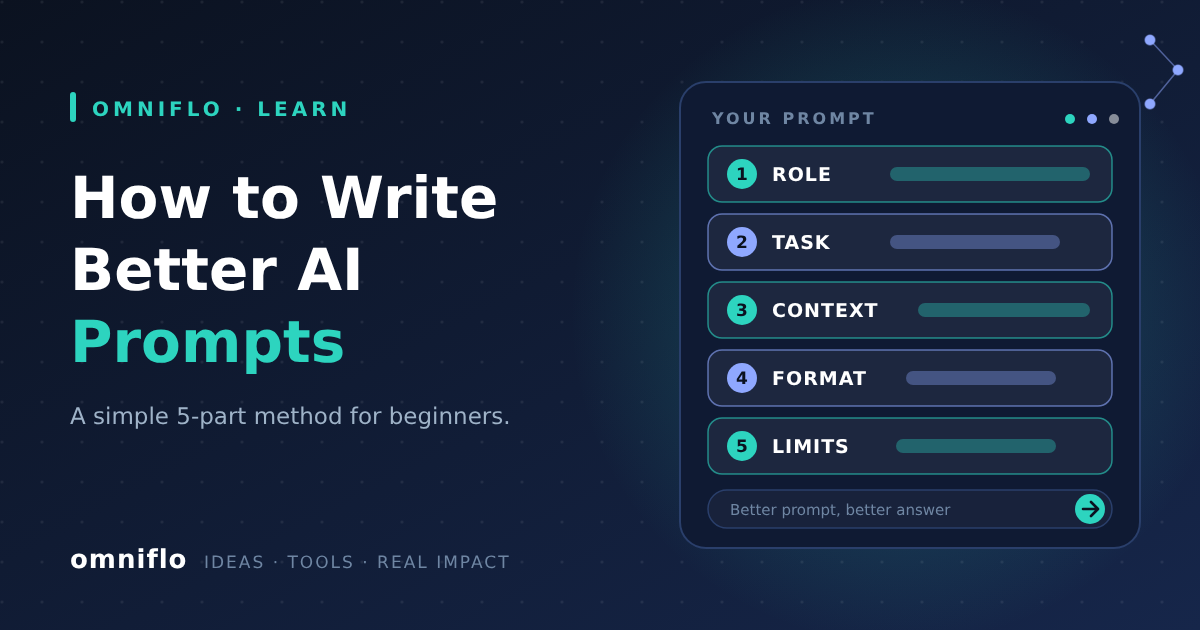
The 5-Part Method
When you want a good answer, try including these five things.
- Role: who should the AI be?
Tell it what kind of helper you need. For example: "Act as a patient teacher," or "Act as a careful editor."
- Task: what exactly do you want?
Be specific. "Summarize," "explain," "compare," "rewrite," "list" are all clear actions.
- Context: what should it know?
Share the background. Who is it for? What is the situation? What have you already tried?
- Format: how should the answer look?
Ask for what you will actually use: a short paragraph, five bullet points, a table, a step-by-step list.
- Limits: what should it avoid?
Set boundaries such as word count, tone, or things to leave out. For example: "Keep it under 200 words and avoid technical terms."
You do not need all five every time. But the more you include, the closer the answer gets.
A Before-and-After Example
Before:
"Help me with my CV."
After:
"Act as a career coach. I am applying for a customer support job and have two years of experience in retail. Rewrite the summary section of my CV in 3 sentences. Keep it professional, confident and simple. Here is my current summary: [paste it here]."
The second prompt gives the AI a role, a task, context, a format and limits. The result is usually much more useful.
Five Habits That Improve Every Prompt
Be specific. "Explain it simply" works better than "explain it." "Explain it as if I am a beginner" works better still.
Give examples. If you want a certain style, show a short sample and say, "Write like this."
Ask for steps. For complicated tasks, say, "Think through this step by step."
Improve it in rounds. Your first answer is a draft. Follow up with "Make it shorter," "Use a warmer tone," or "Give me three more options."
Ask it to ask you. Try: "Before you answer, ask me any questions you need to give a better result."
Common Mistakes to Avoid
Asking for too much at once. Break big tasks into smaller steps.
Being too short. One-line prompts get generic answers.
Trusting the first answer. AI can sound sure and still be wrong. Check facts, names and numbers, especially for anything important.
Sharing private information. Do not paste passwords, personal ID details, or private business secrets into an AI tool.
Try This Today
Pick one task you do often, such as writing an email, planning your day, or explaining something to a customer. Write a prompt using the 5-part method. Compare the result with what you would have got from a one-line question.
You will probably see the difference right away.
Final Thought
AI is a tool, and like any tool, it works better when you know how to use it. Clear questions lead to clearer answers. Better prompts will not replace your thinking. They will help you put it to work.
One useful question. One useful answer. One brick at a time.