
You open an AI tool. You type a question. In seconds, you get a clean, confident answer.
It feels like magic. And it is useful.
But somewhere along the way, a quiet question appears: "If AI does the thinking, what is left for me?"
You are not wrong to ask. AI can write, explain, summarize and plan. Used well, it can save you hours. Used carelessly, it can slowly turn you from a thinker into a copy-and-paste machine.
The good news is that you do not have to choose between using AI and thinking for yourself. You can do both. You just need a few simple habits.
The Real Risk Is Not AI. It Is Autopilot.
AI does not take your thinking away. You hand it over, one small decision at a time.
First you ask it to fix a sentence. Then to write the email. Then to decide what to say, what to buy, what to believe. Each step feels small. Together, they can leave you unsure of your own judgment.
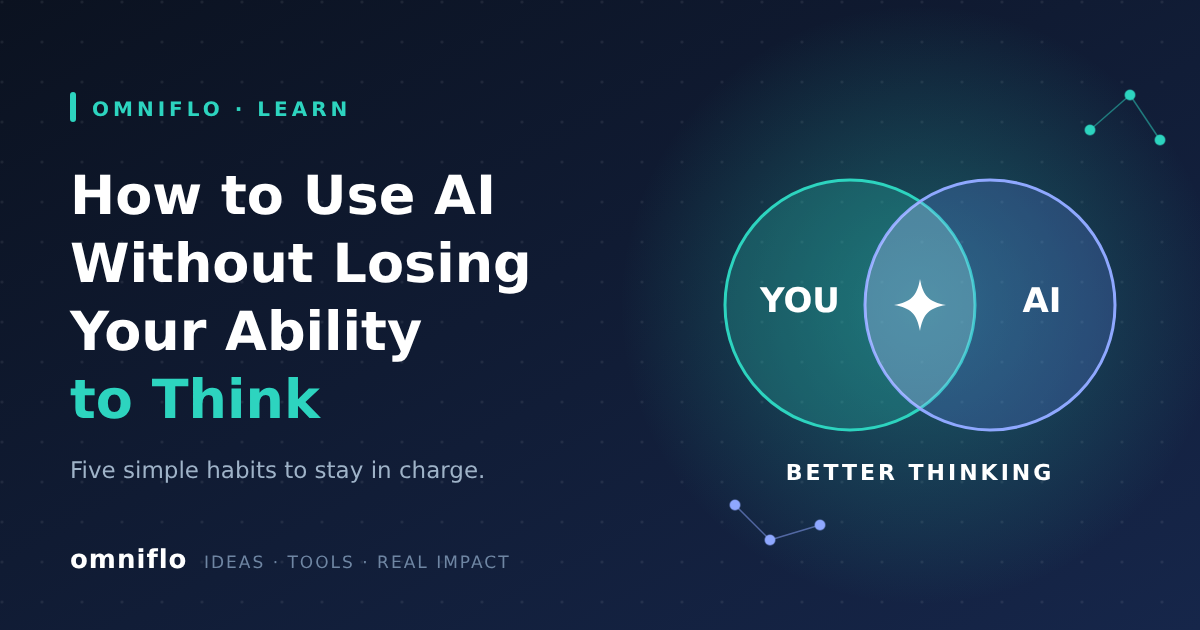
The goal is simple: AI should help you think better, not think for you.
Habit 1: Think First, Then Ask
Before you open the tool, spend one minute with your own thoughts.
What are you trying to solve? What do you already believe? What would your first answer be?
Write it down, even roughly. Then ask AI. Now you can compare. You will see where it agrees with you, where it adds something new, and where it may be wrong.
If you ask first, you only receive. If you think first, you can judge.
Habit 2: Use AI as a Second Opinion, Not the First Voice
A calculator is a good example. It is a wonderful tool. But a person who understands numbers uses it faster and better than someone who does not.
AI works the same way. The more you understand a topic, the better your questions become, and the better the answers you get.
Treat AI like a smart colleague who is sometimes brilliant and sometimes confidently wrong. You would listen, then decide for yourself.
Habit 3: Always Check What Matters
AI can sound sure when it is not. It can invent facts, names and numbers that look real.
So use a simple rule: the more important the decision, the more you check.
A recipe idea? Relax.
A health question? Check with a professional.
Money, legal matters or business decisions? Confirm with reliable sources.
Something you plan to publish? Verify every fact.
A few minutes of checking can save you from a costly mistake.
Habit 4: Ask It to Teach You, Not Just Answer
There is a big difference between these two questions:
"Write this for me."
"Explain how this works, then check my attempt."
The first gives you a result. The second gives you a skill.
Try asking: "Why does this work?" or "What am I missing?" or "Where is my idea weak?" When you use AI this way, every answer makes you a little stronger.
Habit 5: Keep Doing Some Things the Hard Way
Muscles grow when you use them. Thinking is similar.
Choose a few things to keep doing yourself, such as writing a first draft, solving a problem on paper, or planning your week without help. You do not need to avoid AI. You just need to keep the skills that matter to you alive.
Ask yourself: "Which skills do I never want to lose?" Then protect them.
A Simple Test You Can Use Today
After using AI, ask yourself three questions:
Could I explain this answer in my own words?
Do I know why it is right, or do I just hope it is?
Did I learn something, or only receive something?
If you can answer yes, you are using AI well. If not, slow down and go back one step.
The Human Advantage
AI is fast. But speed is not wisdom.
What makes you valuable is not typing faster than a machine. It is your judgment, your experience, your taste, your sense of what matters, and your ability to ask the right question.
AI can supply information. You decide what it means.
Final Thought
Technology becomes useful when people understand how to use it.
Use AI to move faster. Use your mind to move in the right direction. Do both, and AI will not replace your thinking. It will make your thinking go further.
One useful question. One useful answer. One brick at a time.